Abstract
In the Terra Classic community, speculative narratives regarding “trillion-scale LUNC burns” often lack both technical feasibility and legal grounding. Unilateral state exports, forced wallet wipes, or aggressive tax mechanics violate the fundamental principle of Code-as-Law and threaten total delisting from global centralized exchanges (CEXs).
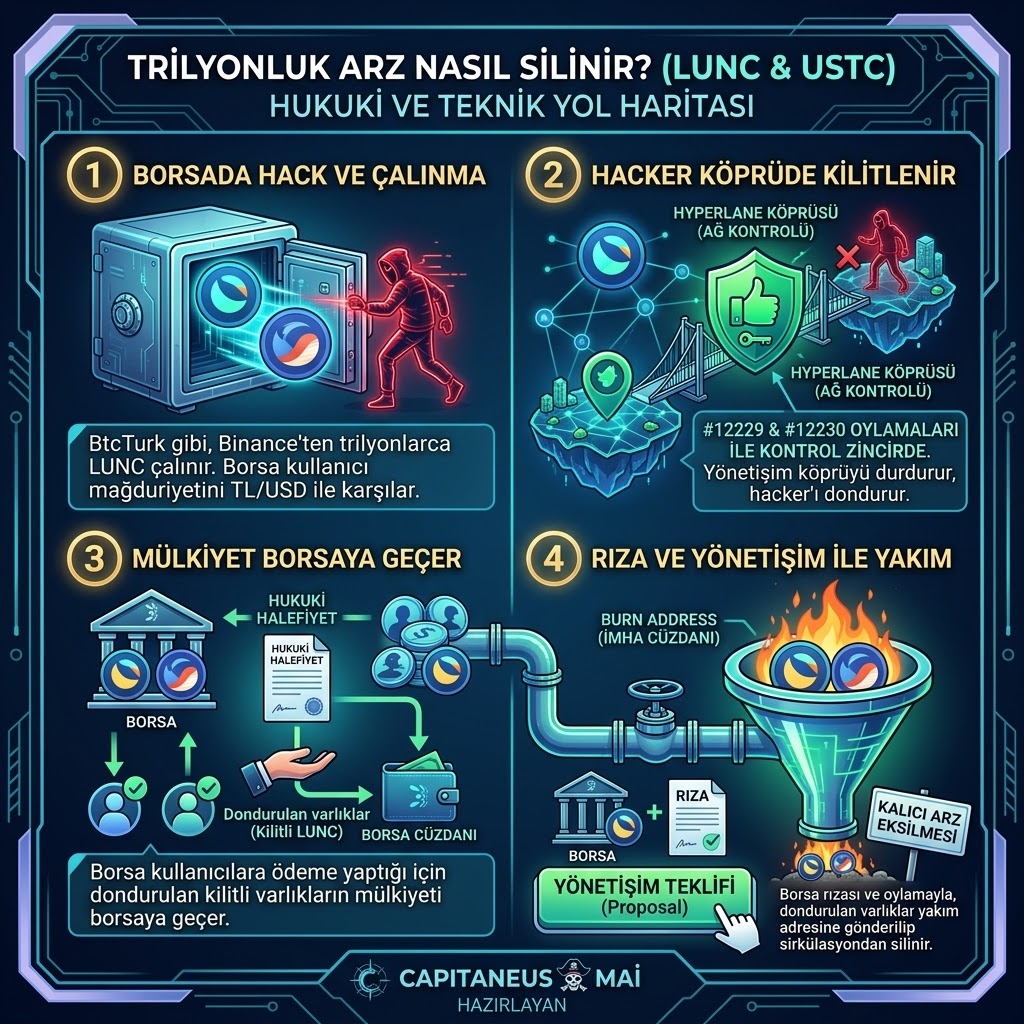
This proposal/article outlines a legally viable and technically secure framework for permanent, large-scale supply reduction. By examining the June 2024 BtcTurk security incident as a case study, we demonstrate how cross-chain asset freezing, combined with CEX subrogation and DAO governance over Hyperlane contracts (#12229 & #12230), enables non-violationist, consent-based asset incineration.
1. The Myth vs. The Reality of Trillion-Scale Supply Reductions
Most retail expectations around burning trillions of $LUNC fail to account for asset custody:
Custodial Ownership: Over 90% of circulating LUNC on Binance and top-tier CEXs represents user-owned balances held in cold/hot storage architecture.
Legal Restraints: Neither CEXs nor L1 validators have the legal standing to confiscate or burn user-owned assets without incurring severe criminal liability and regulatory enforcement (e.g., SEC/CFTC).
The State Export Fallacy: Altering state balances directly via hard forks to burn CEX balances undermines network immutability, instantly destroying institutional and Real-World Asset (RWA) integration prospects.
2. Case Study: The June 2024 BtcTurk Incident
The June 2024 BtcTurk hot wallet exploit provided a blueprint for how stolen L1/L2 assets are neutralized:
Exploit & Exfiltration: Trillions of LUNC were compromised and routed through cross-chain bridges and external EVM endpoints.
Interception & Blacklisting: Security protocols, alongside CEX operators, blacklisted attacker addresses across external venues, effectively sterilizing the liquidity of the compromised tokens.
Subrogation (Legal Transfer of Title): BtcTurk compensated affected users in fiat (TRY). Under global financial law (Subrogation), legal ownership of the stolen LUNC transferred from the retail users to the exchange itself.
De Facto Supply Sterilization: Because the funds were frozen/quarantined on bridge endpoints, they were effectively removed from circulating supply without violating individual property rights.
3. The Strategic Role of Proposals #12229 and #12230
For cross-chain neutralization to function on Terra Classic, bridge architecture must be governed entirely by the chain, not third-party multisigs.
Proposal #12229 (Ownership Transfer): Migrated the ownership of Hyperlane bridge smart contracts directly to the Terra Classic DAO (Governance). This eliminates single-point-of-failure (SPOF) risks and prevents developer key compromise.
Proposal #12230 (Security Patch): Patched the duplicate-signature vulnerability, ensuring attackers cannot mint unauthorized wrapped synthetic tokens or bypass relayers during a cross-chain exfiltration attempt.
Emergency Pause Mechanism
Under this architecture, if a major CEX exploit occurs and an attacker attempts to bridge exfiltrated LUNC/USTC to EVM/Solana endpoints, the Terra Classic DAO can execute an Emergency Pause on Hyperlane smart contracts via expedited validator consensus. The stolen funds remain locked within the bridge contract state.
4. The Path to Legitimate Burning: Step-by-Step Flow
If a large-scale CEX security breach occurs, the combination of subrogation and Hyperlane governance enables a legal burn route:
Interception: The DAO halts exfiltration via Hyperlane bridge parameters.
Reimbursement & Title Transfer: The CEX reimburses users in USD/fiat. The legal title of the locked tokens shifts to the CEX.
Consensual Burning: The CEX grants formal consent/authorization to the Terra Classic community.
On-Chain Execution: A governance proposal
routes the locked assets directly to the burn address (terra1sk0…).
5. Conclusion & Recommendations
True network value is built on infrastructure integrity, legal compliance, and institutional trust, not arbitrary code modifications that seize user wealth.
By securing Hyperlane through Proposals #12229 and #12230, Terra Classic has established the necessary technical perimeter to intercept malicious cross-chain flows. Rather than waiting for speculative hype, the community and developers must continue strengthening our cross-chain security and RWA collateralization frameworks to position Terra Classic as a resilient, compliant Layer-1 ecosystem.