1. Summary
This article proposes that Terra Classic’s market module should be a system with two modes, not a single mechanism. The original market module (MM1) is the main engine, and it runs only when the chain is healthy and strict preconditions are met. A no-mint, Wu Wei-inspired module (MM2) is the safe mode, and it takes over automatically when conditions deteriorate. MM2 never mints LUNA or UST. Together they aim to restore the module’s utility without repeating the 2022 failure.
2. MM1: the engine, and why it remains relevant
The original market module (MM1) was a simple but powerful idea: establish a standing on-chain arbitrage mechanism that allowed users to exchange LUNA for UST, or vice versa, at a protocol-defined 1:1 exchange rate, regardless of the market price of UST.
When UST traded below $1, arbitrageurs could exchange discounted UST for $1 worth of LUNA. When UST traded above $1, they could exchange $1 worth of LUNA for UST and sell it at a premium. The mechanism relied on market incentives rather than committees or discretionary intervention.
What went wrong in 2022?
Terra’s collapse cannot be attributed to a single event or a coordinated attack. It resulted from several interconnected weaknesses.
Anchor Protocol’s advertised yield of approximately 20% attracted substantial UST demand, much of which depended on subsidized returns rather than sustainable organic activity. When confidence weakened, withdrawals accelerated.
At the same time, UST’s stability depended on LUNA absorbing redemption pressure. As UST was redeemed, new LUNA was minted. Falling LUNA prices increased the amount of supply pressure, creating a destructive feedback loop that further undermined confidence.
Market liquidity shocks, including the Curve 3pool imbalance, contributed to the initial depeg. Subsequent changes to the market module’s parameters also increased its redemption and minting capacity during the crisis, accelerating an already dangerous situation. Although coordinated attacks have been suggested, their role has never been conclusively established.
The fundamental lesson is that an elastic supply-based stabilization mechanism can become destructive when confidence and market liquidity disappear simultaneously.
Why MM1 may still be relevant
The failure of Terra does not necessarily invalidate the underlying arbitrage concept. It demonstrates the danger of operating it without sufficiently strong economic and technical safeguards.
MM1 retains three potential advantages:
-
Simplicity and credibility. A transparent, code-enforced rule allows arbitrageurs to participate without discretionary intervention.
-
Market incentives. Price deviations create arbitrage opportunities that can encourage convergence toward the target.
-
Native utility. A built-in exchange mechanism between LUNA and UST provides useful on-chain infrastructure.
The lesson is not to blindly restore the original mechanism, but to redesign its operating conditions.
Any future MM1 implementation must have immutable capacity limits, strict minting ceilings, independent oracle validation, automatic circuit breakers and clearly defined market-health requirements.
MM1 should remain a potential engine for a healthy system, not an unconditional license to expand supply. Its activation must be earned through demonstrable economic resilience, sufficient liquidity and sustained market stability.
3. MM2: the safe mode, its philosophy, and its science
MM2 builds on StrathCole’s no-mint market module proposal on the Terra Classic forum ( Terra Classic Market Module 2.0 (no-mint version) - Proposals - Terra Classic ), which replaces minting with a swap pool filled from burn-tax proceeds. This version extends it with a Dynamic Reference Price and a capacity-based burn.
The philosophy. Taoism has a concept called Wu Wei, achieving without forcing. A dam holds back a river by brute force, and pressure builds behind it until it fails. A channel works with the water’s own energy. A monetary system can be built the same way: stability that comes from incentives the market can follow, not from a promise the system cannot keep.
The Dynamic Reference Price (DRP). Instead of a fixed $1, the reference price is calculated from the current market price (P) and a parameter delta (δ), expressed as a percentage of the market price. For illustration, δ = 1%.
-
If the market price is below $1, the reference price is P × (1 + δ), but never more than $1.00.
-
If the market price is above $1, the reference price is P × (1 − δ), but never less than $1.00.
-
If the market price is exactly $1, the reference price is $1.00.
The cap and floor guarantee that the reference never crosses $1. The mechanism pulls toward $1 and cannot push past it.
How the incentive works on each side of the peg.
-
Below $1. Suppose UST trades at $0.90, so the reference is $0.909. An arbitrageur buys 1,000 UST for $900 and swaps them to the pool, receiving $909 worth of LUNA at the oracle price. The gross margin is about 1% before fees and slippage. The UST leaves circulation and enters the pool, creating upward pressure on its price. The LUNA comes from the pool’s existing balance, and nothing is minted.
-
Above $1. Suppose UST trades at $1.10, so the reference is $1.089. An arbitrageur provides $1,089 worth of LUNA and receives 1,000 UST, worth $1,100 on the market, from the pool’s UST balance. The gross margin is again about 1%. Selling that UST creates downward pressure on its price. If the pool holds no UST, the swap is refused, because nothing is minted.
Delta sets the size of the incentive gap. It must exceed trading fees and oracle latency effects, otherwise the arbitrage is never profitable, but stay small enough that the pool does not lose excessive value on each swap.
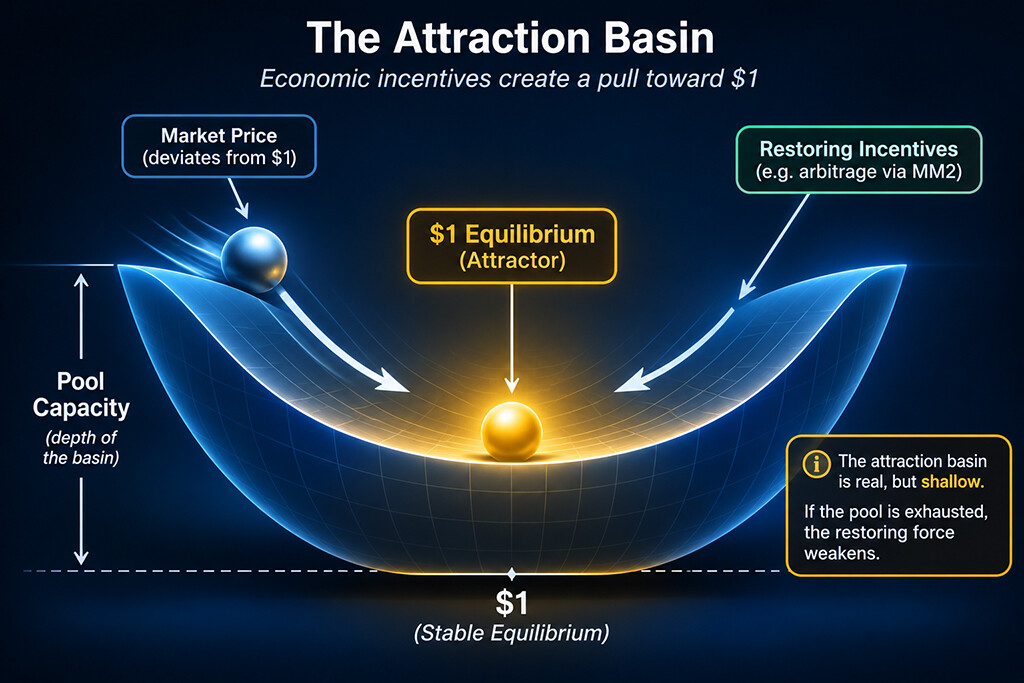
The attraction basin. In dynamical systems, an attraction basin describes the range of conditions from which a system tends to move toward an equilibrium. Imagine a ball in a bowl. Push it away from the bottom and gravity brings it back. The bottom of the bowl is the $1 equilibrium, and the ball is the market price. MM2 aims to create economic incentives that act as a restoring force: when the price moves away from $1, the module rewards activity that brings it closer again.
The restoring force is drawn from the pool’s balances, so it is bounded by the pool’s capacity and by how well burn-tax proceeds replenish it. A larger deviation may need more time and more market activity to correct, and if the pool is exhausted, the force runs out. The basin is real but shallow, and its depth is set by the pool.
Adaptive burning: preserving liquidity while reducing supply
A swap pool that only accumulates tokens would slowly hold more than it needs, and one that burns everything would have no liquidity to offer. Adaptive burning sits between the two with a simple capacity model.
Governance defines a maximum value capacity for each token in the pool, and it can adjust these as the network develops. Once a day, the system values the UST and LUNA balances at a time-weighted oracle price and compares each with its capacity.
-
If the UST balance exceeds its capacity, the excess UST is burned.
-
If the LUNA balance exceeds its capacity, the excess LUNA is burned.
-
If neither balance exceeds its capacity, nothing is burned.
The pool keeps the liquidity it needs, and its balances cannot grow beyond governance-defined limits. Every burn permanently reduces supply, so the same mechanism that keeps the pool useful also keeps it deflationary.
The scientific arguments.
-
Conservation, not expansion. The failure of 2022 came from an elastic supply that absorbed every shock. In MM2 the total supply of both tokens can never rise through the module, so no feedback loop can feed on issuance.
-
Negative feedback. The arbitrage margin pushes against deviations in both directions, rewarding trades that pull the price toward $1.
-
Bounded response. The system cannot promise more than it holds, which is what makes it safe.
-
Homeostasis and metabolism. A living organism does not defy the second law of thermodynamics, which says that disorder (entropy) in an isolated system tends to increase. It survives because it is an open system. It takes in low-entropy resources such as food and energy, uses them to maintain its internal order, and releases waste and heat into its surroundings, so the disorder is exported while its own structure holds. This is metabolism, and it is how an organism keeps its balance (homeostasis) instead of breaking down into disorder. The pool follows the same cycle as an analogy: burn-tax proceeds flow in as fresh resources, liquidity is used for swaps, and adaptive burning releases whatever exceeds the governance-set caps. a system that keeps taking in, using, and releasing can maintain its order over time.
4. How the two modes fit together
The two designs answer different questions. MM1 asks: how do we maintain a peg when the system is healthy? MM2 asks: how do we avoid doing damage when it is not?
The switch. The system runs one mode at a time, and conditions decide which.
-
Engine mode (MM1, hard-limited) runs only while the preconditions hold: the price has stayed in a defined corridor around $1 for a sustained period, LUNA’s market cap is large relative to circulating UST, and oracle participation is healthy.
-
Safe mode (MM2) takes over automatically when a trigger fires, such as a TWAP deviation beyond the corridor, loss of oracle quorum, or an abnormal minting rate. It stays on until conditions have held for a sustained period.
-
Hysteresis. Entry and exit thresholds differ, so the system does not flicker between modes.
Where we stand today. UST trades far below $1, so the engine’s preconditions fail. We would start in safe mode, with no minting of either token and a pool funded by burn tax, and earn our way to the engine through sustained recovery.