Market Module 3.0 — LUNC burn with a defended USTC bid
Feasibility-study proposal for the Terra Classic community · October 20, 2026 · v0.3
The question before the proposal
This proposal only works if USTC holders accept a trade: USTC gains a defended bid that is never lowered, and a mint ceiling above a band; in exchange, every dollar of demand above the band becomes LUNC burn. USTC stops appreciating freely above the band. If the USTC community prefers an uncapped token with the repeg lottery intact, the proposal should not go forward, and it is better to learn that in the forum than after a deployment. The first next step is a poll on exactly this question.
Summary
Market Module 3.0 is the evolution of the module that already exists on the chain: a one-way Market Module in which LUNC only enters by being burned and is never minted. LUNC becomes USTC when the market pays more than a band above a reference price; USTC is bought back below that reference by a backstop token, TCB (Terra Classic Backstop), whose minting is capped and budgeted. The reference is a defended bid with a published limit: it is never lowered, it steps up behind the market when capital allows, and when the backstop’s limit is reached USTC trades wherever the market puts it. This is a feasibility-study proposal with a test environment open to the community; there is no request for a mainnet deployment.
What it is: a Market Module with three changes: the LUNC route is one-way, the absorber’s minting has a per-epoch cap and a cumulative budget, and the price always comes from the validators’ oracle. USTC minting, disabled since 2022, is re-enabled only through the module: every new USTC is born by burning LUNC (or TCB, with a spread).
What it is not: it is not a USTC repeg to US$ 1 and does not promise one; covering 5.6 billion USTC at US$ 1 would need about US$ 11 billion of capital. It is not a floor the price cannot cross. The honest description: TCB is endogenous collateral, worth what the module’s future revenue and the community’s belief make it worth, and it falls when USTC is under stress. The cap and the budget bound the damage; the USDC reserve is the only exogenous part and it is small. The failure mode is the status quo: the backstop absorbs up to its budget, then stops, and USTC floats as it does today. LUNC is never touched.
What the LUNC community gains: burn proportional to demand for USTC above the band. In the simulation, demand growth of 10% a month for five months burns about 280B LUNC; sustained growth for a year, about 1T. With no demand nothing is minted and nothing is burned. No scenario mints LUNC.
What the USTC community gains: a bid that is never lowered, defended by TCB and the reserve up to a published limit, and that steps up behind the market as capital grows. What it gives up: the upside above the band.
What happened to LUNA and UST in 2022
Arbitrage did not fail in May 2022; it worked exactly as designed, and that is what took LUNA’s supply from about 350 million to about 6.5 trillion in a few days. Arbitrage transfers losses to whoever holds the absorbing token; it does not create value. Four causes reinforced each other:
-
Artificial demand for UST, bought with Anchor’s 19.5% yield. When the subsidy dried up, demand left at once.
-
Endogenous collateral. UST was backed by LUNA, whose value depended on UST demand. Every UST burned minted LUNA without limit.
-
An exit narrower than the run. The virtual pool absorbed hundreds of millions a day while billions tried to leave.
-
Oracle and governance lagged the crash.
This proposal answers each: no subsidized yield and no promise of US$ 1 (1); an absorber that is still endogenous but capped, budgeted and bonded, plus an exogenous reserve (2); exit capacity measured and published every epoch (3); a TWAP oracle with automatic pause (4).
Architecture
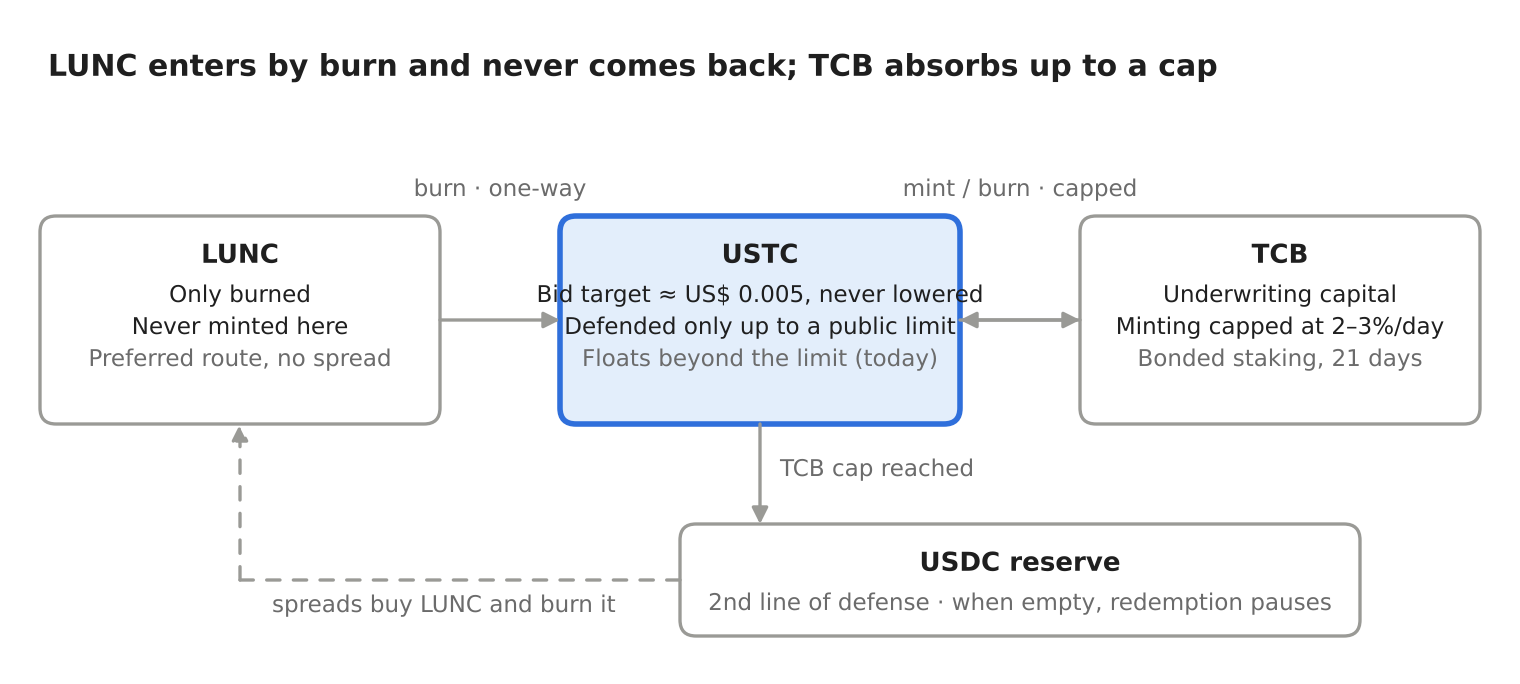
LUNC’s arrow only points right: a collapse in the USTC/TCB pair cannot mint LUNC. The reflexivity that destroyed LUNA is confined to TCB, with a cap and a budget, and the reserve steps in when the cap is reached.
The three tokens
| Token | Role | What the protocol promises | Who holds it and why | Risk |
|---|---|---|---|---|
| LUNC | Entry | Only burned by this module; never minted | Already exists; the community gains the burn | No new risk |
| USTC | Currency with a defended bid | A bid at the reference, never lowered, defended up to a published limit; a mint ceiling above the band; floats beyond the limit | Current holders (5.6B in circulation, listed on exchanges); anyone who wants a fractional on-chain dollar | Trades below the bid in a run that exceeds the backstop, i.e. today's situation; no upside above the band |
| TCB | Backstop capital | Absorbs losses up to a cap per epoch and a budget per bid level; receives spreads and seigniorage | Those betting that USTC demand grows and the bid steps up; accept limited dilution | High; endogenous; likely a security (see Risks) |
USTC keeps the uusd denom and its exchange ticker. TCB is a working name; the token must not be called ARB, which is Arbitrum’s ticker.
Mechanism
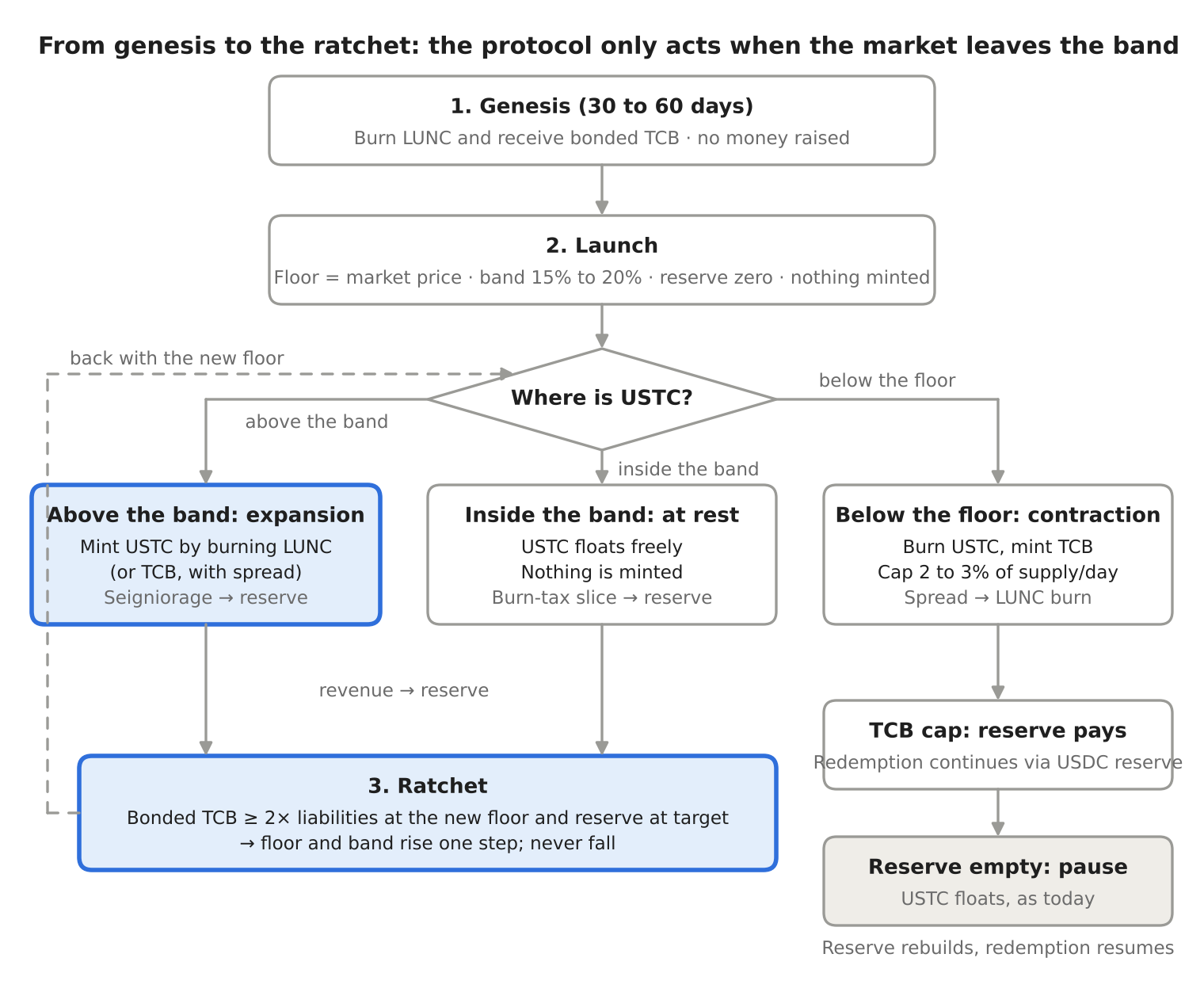
Reference (R) and band (b). R is set at launch to the oracle price of USTC (about US$ 0.005). The mint route opens only when the USTC TWAP is above R × (1 + b), with b between 15% and 25%. Inside the band the token floats freely and holders keep the upside. Below R the backstop route opens.
Expansion (USTC above the band). The arbitrageur mints USTC at the band top by burning LUNC (preferred route, 1% seigniorage to the reserve) or TCB (1% spread, only up to the amount minted in the last contraction), and sells the USTC into the demand that opened the route. Minting is capped at 2% of USTC supply per epoch. The protocol never mints USTC on its own initiative.
Contraction (USTC below the bid). The arbitrageur buys cheap USTC, burns it and receives R in TCB at the TCB oracle TWAP, paying a spread of 0.5% that rises to 2% as the daily cap fills. TCB minting is capped at 2% to 3% of TCB supply per epoch (measured at epoch start) and at 100% of TCB supply per bid level in total; the budget resets only when the bid steps up. Beyond the cap the reserve pays in USDC; when the reserve is empty, redemption pauses for the epoch and the route reopens at the next epoch while budget remains. When the budget is spent, the backstop is closed until the bid steps up or governance tops up the reserve.
Liquidity gate for the contraction route. The route is live only while the TCB market meets a published depth (initial proposal: 10% of USTC liabilities within 5% of mid, as measured by the oracle feeders) and TCB has at least two oracle sources. Below the gate, the module is expansion-only. This is a parameter of the module, checked every epoch, not a one-time launch condition.
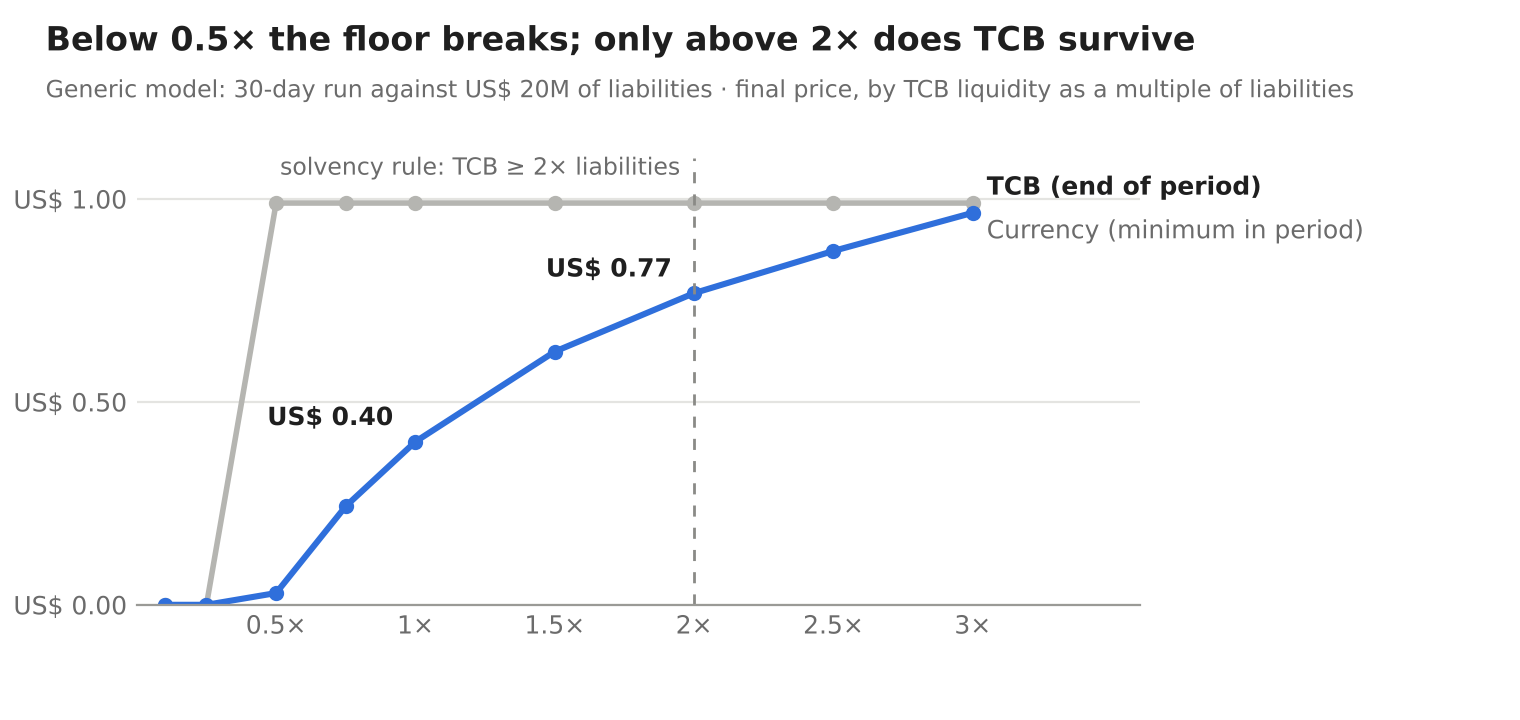
Trailing bid step. After 30 consecutive epochs with the TWAP above the band and the market already at the new level, R steps up by 10% (never more than the band) if bonded TCB plus reserve cover 2× supply × the increment (about US$ 5.6M per step at today’s supply) and the reserve holds 2% of supply × the increment. R never steps down.
Oracle. USTC and TCB prices come from the validators’ oracle with median and 1-hour TWAP; pools are never a reference. On the mint side LUNC is priced at the lower of its TWAP and its latest sample, and a 10% deviation from the 24-hour TWAP pauses the route for the epoch. A stale feed closes every route. A TCB drop above 15% in an epoch closes the routes for that epoch.
TCB genesis and staking. TCB is created by burning LUNC in a 30–60 day window, pro rata, with the tokens already bonded (21-day unbonding). No sale, no money raised. Only bonded TCB counts for cover, receives spreads and seigniorage and governs the module’s parameters. Unbonded TCB does not protect anything.
Reserve. Seigniorage (USTC) and a 20% slice of the burn tax for 12 months (LUNC) are sold for USDC in daily on-chain auctions against bids at the oracle TWAP minus a bounded discount (2%, widening to 5% after a week). The module never calls a bridge. Until the reserve reaches 2% of liabilities, all revenue goes to it; afterwards revenue is split between LUNC buy-and-burn, the Oracle Pool and TCB stakers, by governance.
Who mints what, and when
| Token | Minted when | Limit | Burned when |
|---|---|---|---|
| LUNC | Never, by this module | — | Expansion (preferred route); spreads; TCB genesis |
| USTC | Above the band, by burning LUNC or TCB | 2% of supply per epoch; only real demand | Contraction, below the bid, by whoever wants TCB |
| TCB | Below the bid, in contraction | 2–3% of supply per epoch; 100% of supply per bid level; liquidity gate | Expansion through the spread route, up to recomposition |
Limits and fees
| Parameter | Proposed initial value | What happens at the limit |
|---|---|---|
| Reference at launch | Oracle price of USTC | Day one at rest; nobody diluted |
| Band | 15% to 25% | Above it, demand mints USTC by burning LUNC |
| Seigniorage (LUNC route) | 1% | To the reserve |
| TCB-route spread | 1% | Keeps LUNC the preferred route |
| Contraction spread | 0.5% → 2% as the daily cap fills | Same logic as the original virtual pool |
| USTC mint cap | 2% of supply per epoch | Excess demand waits |
| TCB mint cap | 2–3% of supply per epoch, at epoch start | Reserve pays; then pause for the epoch |
| TCB mint budget | 100% of supply per bid level | Backstop closed until a step |
| Liquidity gate | TCB depth ≥ 10% of liabilities; ≥ 2 oracle sources | Contraction route closed below it |
| Reserve target | 2% of liabilities | Revenue split starts above it |
| Bid step | +10% after 30 epochs above the band; cover 2× the increment | Never steps down |
| Breaker | TCB −15% in an epoch | Routes closed for the epoch |
| Oracle | 1-hour TWAP; max feed age; LUNC 24-hour deviation 10% | Routes closed while stale |
Fees are low on purpose: a high spread kills arbitrage. The arbitrageur only acts when the deviation covers spread, price impact and gas.
What the simulation shows
The spec was implemented as a daily simulator (sim_mm3.py) and run against eight scenarios, a genesis sweep and 3,000 randomized year-long trajectories with the module’s invariants checked every epoch. The full report is published with this proposal.
Invariants, 3,000 random trajectories (1.1 million epochs): zero violations. LUNC never minted; TCB never above its cap or budget; the bid never lowered; the reserve never negative; no route open on a stale oracle.
| Genesis (LUNC burned) | TCB capital | Lowest USTC in a −30% run (% of bid) | Bid steps in year one (demand +10%/month ×5) | LUNC burned in year one |
|---|---|---|---|---|
| 50B | US$ 2M | 76% | 0 | 329B |
| 200B | US$ 10M | 85% | 1 | 407B |
| 300B | US$ 15M | 89% | 2 | 451B |
| 500B | US$ 25M | 94% | 2 | 651B |
| 1,000B | US$ 50M | 97% | 2 | 1,151B |
Reading it honestly: defending a 30% run needs TCB capital on the order of USTC’s liability, roughly 1T LUNC burned at genesis. With less, the backstop absorbs up to its budget and USTC floats. With 1T, USTC never fell more than 2% below the bid in a 30% run and was back at the bid two days after the run ended; TCB was diluted 16% and lost a quarter of its price, which is its job. Bonded staking contained a holder flight: an 8% dip instead of 2%.
Two pessimistic cases asked for in community review: with TCB liquidity at 2% of genesis value, a −30% run bottoms at US$ 0.0037, the same as having no backstop, and the budget is spent for almost nothing; with TCB priced at ten times expected annual revenue (about US$ 6M), the run bottoms at US$ 0.0041. This is why the contraction route carries a liquidity gate.
The simulation changed the design in three places before this version: a per-epoch cap alone compounds to about 1,500× in a year (hence the budget); a solvency rule on the whole liability is unreachable (hence the trailing step on the increment); a 10% reserve target is unreachable from fees (hence 2%, with the burn-tax slice as the main source in year one).
Risks and what we do not promise
Blocking question first: TCB is likely a security. Holders receive revenue generated by others’ activity; paying for it with burned LUNC rather than dollars probably does not change that. A legal opinion is required before any genesis window opens. If the opinion is negative, the module can still ship with the contraction route disabled (LUNC burn on demand, no backstop token), which is most of its value in year one.
| Risk | Treatment | What remains |
|---|---|---|
| USTC holders reject the ceiling | Poll first; band width is theirs to set | If rejected, the proposal stops |
| Demand never exceeds the band | Nothing minted, nothing burned | The module idles; the burn is conditional on USTC demand |
| TCB is endogenous collateral | Cap, budget, bonded staking, liquidity gate, reserve | In a run the loss lands on TCB holders; defense capacity equals TCB capital |
| Thin TCB market, oracle pushed around | Liquidity and source gates; TWAP; breaker | Highest right after the gate opens |
| Capital needed is large | Trailing steps on the increment only | Full defense needs ~1T LUNC of genesis |
| Holders of minted USTC lose when demand fades | Stated plainly; mint cap; the bid is the only support | No support when the backstop is closed |
| LUNC oracle manipulation on the mint side | min(TWAP, latest); 24h deviation pause; 2%/epoch cap | Bounded, not zero |
| Burn-tax slice undercuts "LUNC only gains" | 20% for 12 months, by vote; governance may redirect the reserve | A real transfer from burn to reserve |
| Regulation of a dollar-referenced token | No promise of parity; published bid and limits | Legal opinion before genesis |
The sentence the community needs to accept: USTC gets a defended bid with a published limit, paid for by real capital; above the band it does not appreciate, and beyond the limit it floats. If this is read as a “repeg”, it will be held to US$ 1 and rejected.
Next steps
-
Poll USTC holders on the trade (ceiling above a band, defended bid, no promise beyond the limit) and on the band width.
-
If accepted, approve the feasibility study: simulator and local testnet with the oracle-feeder, USTC and TCB pools, open to anyone.
-
Commission the legal opinion on TCB before any genesis.
-
Results report with the parameters that survived the stress test and those that did not.
-
Only then, if the community wants it, a separate deployment proposal.
Open questions for the forum:
-
Band width: 15%, 20% or 25%?
-
Fixed TCB supply at genesis, and window length?
-
Burn-tax slice for the reserve: 20% for 12 months, less, or none?
-
Liquidity gate level for the contraction route?
-
Does the bid step automatically or by vote?
-
A better name than TCB for the backstop token.