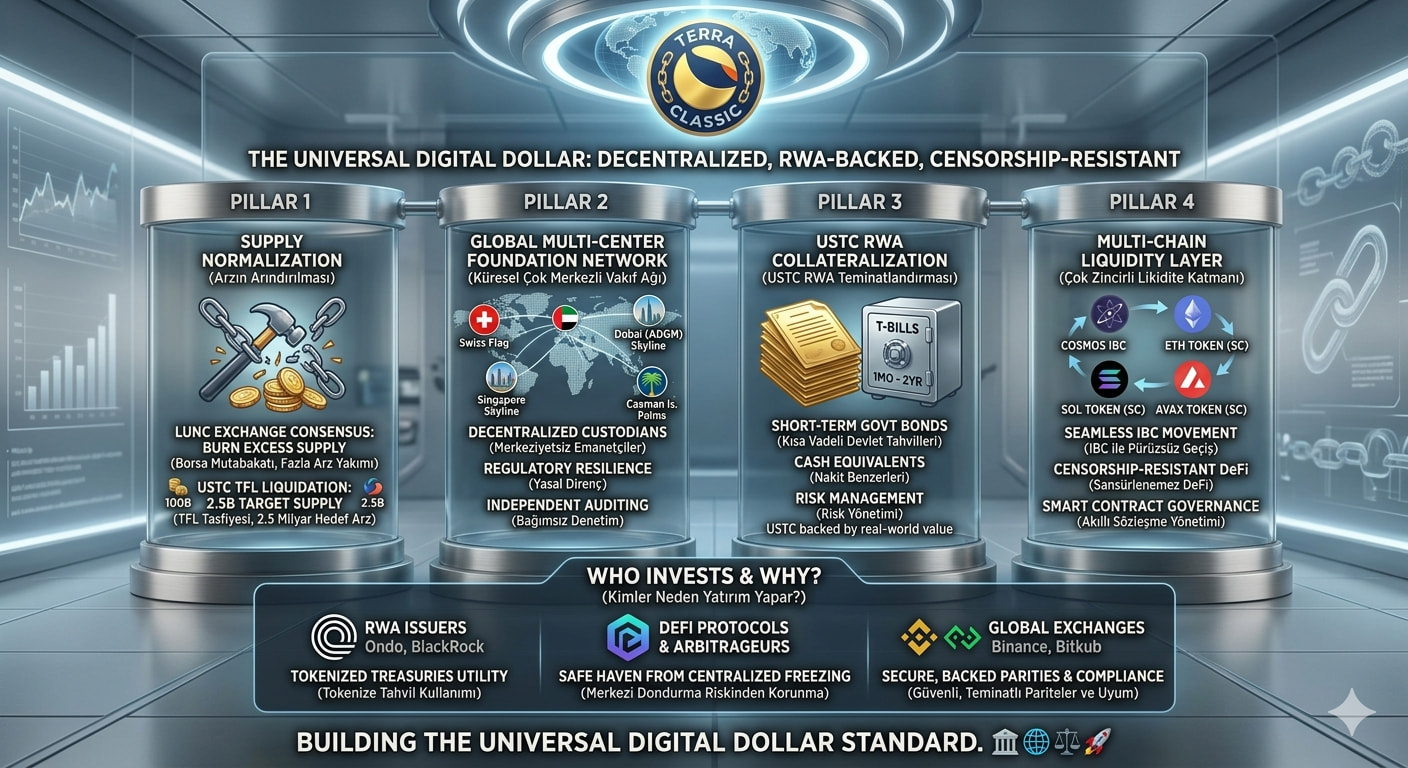
Phase 1: Strategic Supply Normalization (Cleaning the Slate)
LUNC (Exchange Consensus): On-chain data proves that over 90% of the circulating supply is held within the top 54 wallets, primarily controlled by major exchanges. We propose a consensus with entities like Binance and Bitkub to burn the “excess supply” originating from the 2022 minting event that remains as exchange-side liquidity rather than retail holdings.
USTC (TFL Liquidation): Following the Terraform Labs (TFL) liquidation process (concluding by Dec 2026), all TFL-linked USTC assets held in escrow or exchange custody must be burned. Target: Reducing USTC supply to a manageable and backable 2.5 Billion.
Phase 2: Global Multi-Center Foundation Network
Instead of a single point of failure, we will establish a decentralized network of foundations in various regulatory jurisdictions (e.g., Switzerland, Dubai/ADGM, Singapore).
Regulatory Resilience: Legal changes in one jurisdiction will not paralyze the entire protocol.
Independent Auditing: Each foundation will act as a legal custodian and auditor for the short-term (1 month to 2 years) government bonds held in its respective region.
Phase 3: RWA Collateralization of USTC
USTC will evolve from a purely algorithmic model to a Value-Backed Reserve Asset.
Asset Filter: The treasury will strictly collateralize USTC with high-liquidity, short-term (T-Bills) and cash-equivalent Real World Assets (RWA).
Risk Management: By avoiding long-term (10-30 year) bonds, the protocol ensures it remains solvent and liquid regardless of interest rate volatility.
Phase 4: Multi-Chain Liquidity Layer (IBC & Smart Contracts)
USTC will leverage Terra Classic’s native IBC power to become a universal reserve currency across the blockchain landscape.
Native IBC: Seamless and secure movement across the entire Cosmos ecosystem.
Smart Contract Implementation (ETH, SOL, AVAX): USTC will exist on major networks like Ethereum, Solana, and Avalanche through advanced smart contracts.
The Decentralization Advantage: Unlike centralized assets (USDT/USDC) that grant a single entity the power to “freeze” funds, the multi-chain USTC will be governed by code and a decentralized foundation network, offering a censorship-resistant and superior alternative.
The Investment Thesis: Who Invests and Why?
1. RWA Issuers (BlackRock, Ondo Finance, etc.)
Why? These institutions are seeking high-volume, “on-chain” utility for their tokenized treasuries (e.g., BUIDL).
Motivation: Becoming the primary collateral provider for a 2.5 billion USTC market allows these giants to scale their Assets Under Management (AUM) and integrate their products into a global decentralized payment rail.
2. DeFi Protocols & Arbitrageurs
Why? Seeking a “Safe Haven” that is free from the centralized freezing risks of Tether or Circle.
Motivation: A multi-chain, bond-backed USTC becomes the new “Gold Standard” for DeFi. Arbitrageurs will provide deep liquidity by leveraging the speed of IBC to capitalize on cross-chain price efficiencies.
3. Global Exchanges (Binance, Bitkub, etc.)
Why? Providing users with a secure, regulated, and yield-bearing paritites.
Motivation: Exchanges can list a “Next-Gen USTC” that is fully backed by treasuries, significantly easing their Proof of Reserves (PoR) and compliance burdens while driving massive trading volume.
Final Vision
"We are not just saving a single network; we are merging law, finance, and technology (IBC/Smart Contracts) to build the Universal Digital Dollar—decentralized, censorship-resistant, and backed by the real-world value of sovereign debt."