Classic Chaos Podcast - S2E04 - Beating the Odds
Probability models, governance experiments, and the eternal struggle between “hope” and “hard math.” Will Terra Classic defy the odds or just keep debating committees? We crunched the numbers so you don’t have to. 

Scenario-based probability analysis of Terra Classic’s likelihood of achieving its three core success metrics
Based on recent findings about validator behavior, the state of L1 versus L2 development, and ongoing issues around governance and marketing. The three success metrics remain:
-
L1 revenue and Oracle pool stability,
-
Revitalizing USTC or introducing a major new product,
-
LUNC price exceeding $0.0006.
We compare three main scenarios:
-
Scenario A: Fully decentralized Terra Classic, no formal roadmap or legal entity.
-
Scenario B: Terra Classic maintains decentralized consensus but establishes a legally recognized foundation or DAO to handle marketing, partnerships, funding, and compliance.
-
Scenario C: Terra Classic remains decentralized but is supported by a central foundation (or DAO) headed by a well-known, highly experienced blockchain entrepreneur (e.g., a figure such as Changpeng Zhao, ex-CEO of Binance), similar to how Terra once had Terraform Labs.
I. Methodology Overview
We apply a scenario-based weighted scoring method:
-
Identify Key Factors affecting success (e.g., governance, product development, Oracle pool, stablecoin revitalization, market sentiment).
-
Assign Scores (0–10) to each factor, reflecting Terra Classic’s current performance as indicated by the new data.
-
Apply Weights (%) indicating each factor’s relative importance to achieving the three success metrics:
-
(A) Generating L1 revenue & stabilizing the Oracle pool,
-
(B) Revitalizing USTC or introducing a flagship product,
-
(C) Achieving a LUNC price above $0.0006.
-
Sum the weighted scores to produce a “success index.”
-
Interpret that index as a probability range.
We again assess:
-
Scenario A: Fully decentralized Terra Classic, no formal roadmap or legal entity.
-
Scenario B: Terra Classic maintains decentralized consensus but establishes a legally recognized foundation or DAO to handle marketing, partnerships, funding, and compliance.
-
Scenario C: Terra Classic remains decentralized but is supported by a central foundation (or DAO) headed by a well-known, highly experienced blockchain entrepreneur (e.g., a figure such as Changpeng Zhao, ex-CEO of Binance), similar to how Terra once had Terraform Labs.
II. Key Factors Influencing Terra Classic’s Success
2.1 Governance & Community Coordination
Validator Inaction & Unprofessionalism:
- Numerous validators do little or nothing (some are entirely inactive in governance but still collect staking rewards).
Major issues:
-
No project management tools, limited communication.
-
~47% of governance proposals see no validator votes.
-
Community Pools remain large (~$1.8M–$2M), but lack of leadership prevents effective usage.
-
Fragmented Decision-Making
-
No single roadmap.
-
Multiple discussions about the need for a plan, yet no one drives execution.
-
70% “play politics,” 15% sabotage or do nothing, only 15% actively try to rebuild.
Score (Scenario A): 2/10 – The raw data confirms serious governance paralysis.
Score (Scenario B): 4/10 – A legally recognized foundation could impose accountability but must still overcome severe validator apathy.
Score (Scenario C): 6/10 – Decentralized chain, but guided by a central foundation led by an experienced entrepreneur. Gains:
-
A strong leader and staff can drive decision-making, unify validators, handle community conflicts, and impose accountability.
-
Brand credibility from a proven track record in large-scale blockchain development. Weight: 20% – Governance is central to passing crucial proposals and mobilizing community funds.
2.2 Product Development & Technical Roadmap
L1 Neglect, L2 Flourishing:
-
L2 projects (Terraport, Selenium, Juris) are more active, often reaping profits at L1’s expense.
-
Terra Classic has not restored its once-popular L1 product (the original stablecoin utility or main DeFi features).
-
Documentation is outdated and incomplete—15 mentions in validators’ chats but no action.
-
Zero L1 Flagships
-
Raw data: in 3 years post-crash, no major new L1 product.
-
L2 has hundreds of tokens, but little to no synergy for L1 upgrades.
Score (Scenario A): 2/10 – The data highlights near-total L1 stagnation.
Score (Scenario B): 5/10 – A foundation/DAO might hire dev teams to build or restore main L1 products, but success depends on budget + unified direction.
Score (Scenario C): 6/10 – A central foundation can hire dev teams and push a structured roadmap, as Terraform Labs once did. Gains:
-
Direct oversight to maintain or upgrade the chain.
-
Clear lines of responsibility and funding for L1 tasks.
Weight: 20% – L1 product viability is crucial for revenue and Oracle pool replenishment.
2.3 Oracle Pool Sustainability
-
Ongoing Decline
-
Oracle pool under 90B LUNC, steadily shrinking.
-
Staking APR ~7.86%, continuing to drop.
-
If no fix, the pool might run dry in ~2 years, bankrupting the chain’s staking mechanism.
-
Validators’ Apathy
-
No cohesive plan to replenish the pool.
-
Community suggestions exist but stall in governance.
Score (Scenario A): 3/10 – Data suggests slow motion depletion with no real fix.
Score (Scenario B): 5/10 – A legal entity could push proposals to direct fees or new revenue into the pool.
Score (Scenario C): 6/10 – A foundation / dao can restructure tokenomics or channel fees into the pool, supported by expert financial strategists. Gains:
-
Potential to enact stable or creative solutions to revitalize staking APR.
-
Faster decision-making if the leader and foundation have recognized authority.
Weight: 15% – If the pool collapses, L1 loses security and stakers.
2.4 USTC Revitalization / New Flagship Product
Raw Data:
-
Multiple proposals (Divergence Protocol, “Re-Pegging USTC,” etc.) remain theoretical; none reached production.
-
Various ideations: “gold-pegged stablecoin,” new L1 product. -Community is aware of stablecoin’s potential but sees no cohesive plan. -Competition & L2 Exploits -Some L2 teams push new stablecoins. Other blockchains “steal” the UST brand for a BTC-backed stablecoin separate from Terra Classic with support of some Terra Classic Validators.
-
Data reveals “AutoStake, THORChain, RUJIRA, Bioeconomy” are forging their own path, effectively ignoring L1.
Score (Scenario A): 2/10 – 3 years of no stablecoin revival strongly implies low success.
Score (Scenario B): 5/10 – A foundation might sponsor an external specialist or partner (Circle, Tether) to reconstruct USTC.
Score (Scenario C): 6/10 – A recognized entrepreneur-led foundation can collateralize or re-engineer USTC, or launch a major new product. Gains:
-
High-level partnerships (CEX, big DeFi projects) are more feasible with known leadership.
-
Brand recognition from the founder’s proven success (like BNB or Solana) can attract devs, liquidity, and trust.
Weight: 15% – Without a stablecoin or similarly large product, the chain struggles to differentiate.
2.5 Market Sentiment & LUNC Price (> $0.0006)
-
Current Price: ~$0.0000748 (Jan 29, 2025).
-
Downtrend: Price chart and Google Trends data in a downward slope. Terra Classic since crash in May 2022 has hit its highest price around September of the same year. It was $0.0006. Since then, Terra Classic (LUNC) has not returned to that level and has been in a continuous downtrend and has been hitting cyclical lower highs.
-
USTC Crash Legacy: Negative brand association hinders new investors.
-
Competition: Other Cosmos chains (ATOM, Injective) show higher engagement.
Score (Scenario A): 2/10 – The brand’s negativity, minimal marketing, and no official website hamper major price recovery.
Score (Scenario B): 4/10 – Coordinated marketing, a new stablecoin product, or a successful roadmap could attract fresh capital—but bridging from $0.00007 to $0.0006 is a ~700–800% jump.
Score (Scenario C): 5/10 –A well-known entrepreneur fosters marketing, branding, exchange listings, and investor confidence. Gains:
-
Potentially faster listings, big partnerships (as Binance or other major networks once leveraged).
-
Investors more likely to trust a chain with recognized leadership.
Weight: 20% – Price is a direct reflection of confidence and adoption.
2.6 Macro Conditions of the Crypto Market
-
Volatile Recovery Phase (Early 2025)
-
BTC dominance near 42%, altcoins see moderate inflows.
-
Regulators (EU, U.S.) imposing stablecoin frameworks, scrutinizing “algorithmic” designs.
-
Investor Risk Appetite
-
Institutions still hesitant toward unregulated, high-risk altcoins.
-
Retail interest in meme coins / small caps can surge but is short-lived.
Relevance for Terra Classic:
-
Algorithmic stablecoins face extra regulatory hurdles.
-
Harder to secure major listings or partnerships without a strong compliance strategy. (This factor is embedded across our scoring for governance, product dev, stablecoin feasibility, etc.) 2.7 Comparative Analysis of Other L1 Projects
Ethereum:
-
Large dev community, well-established stablecoins (DAI, USDC bridging).
-
Transitioned to PoS, robust governance, advanced DeFi ecosystem.
BNB Chain:
- Centralized backing by Binance, strong liquidity, lower fees, multiple stablecoins.
Cosmos (ATOM):
-
Thriving with Inter-Blockchain Communication (IBC), simpler dev environment.
-
Better developer docs, multiple successful stablecoin or cross-chain initiatives.
Avalanche:
- Fast finality, active marketing, numerous DeFi apps.
Terra Classic:
-
Lacks official website, marketing, up-to-date docs, or strong dev community.
-
Governance dysfunction vs. competitor L1s with stronger foundations. (This influences the viability of attracting devs, users, and capital to Terra Classic.)
III. Weighted Scoring & Probability Calculation
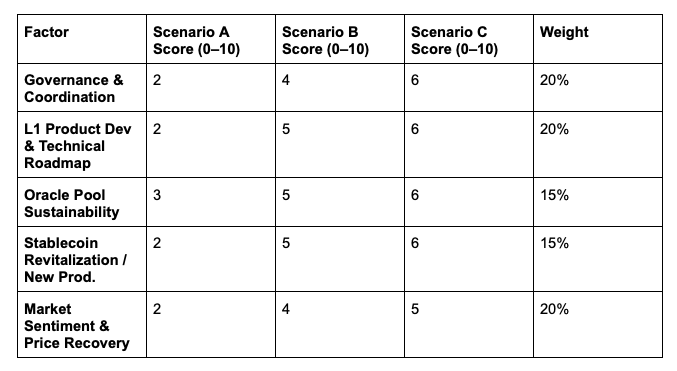
3.1 Scenario A: Fully Decentralized, No Foundation
Governance & Coordination: 2/10 × 20% = 0.40
L1 Product Dev & Roadmap: 2/10 × 20% = 0.40
Oracle Pool: 3/10 × 15% = 0.45
Stablecoin Revitalization: 2/10 × 15% = 0.30
Market Sentiment & Price: 2/10 × 20% = 0.40
Total Success Index (Scenario A) = 0.40 + 0.40 + 0.45 + 0.30 + 0.40 = 1.95 (out of 10)
Interpretation:
-
A ~2/10 index corresponds to a very low probability (under 20%) of meeting all success criteria within 12–24 months.
-
Reflects severe governance deficits, absent L1 roadmap, minimal stablecoin progress, and a depressed LUNC price.
Estimated Probability (Scenario A): 5% to 15% chance of achieving the three success metrics in 12–24 months.
3.2 Scenario B: Decentralized + Legally Recognized Foundation/DAO
Governance & Coordination: 4/10 × 20% = 0.80
L1 Product Dev & Roadmap: 5/10 × 20% = 1.00
Oracle Pool: 5/10 × 15% = 0.75
Stablecoin Revitalization: 5/10 × 15% = 0.75
Market Sentiment & Price: 4/10 × 20% = 0.80
Total Success Index (Scenario B) = 0.80 + 1.00 + 0.75 + 0.75 + 0.80 = 4.10 (out of 10)
Interpretation:
-
A ~4.1/10 index suggests a moderately low but notable improvement over Scenario A.
-
With a foundation/DAO, Terra Classic can possibly fund dev teams, enforce accountability, and market effectively, but still faces serious brand damage, minimal dev docs, and major LUNC price climb needed.
Estimated Probability (Scenario B): 15% to 25% chance of meeting success metrics in 12–24 months.
3.3 Scenario C: Decentralized Chain, But Supported by a Well-Known Entrepreneur-Led Foundation
Governance & Coordination: 6 × 20% = 1.20
L1 Product Dev: 6 × 20% = 1.20
Oracle Pool: 6 × 15% = 0.90
Stablecoin / Product: 6 × 15% = 0.90
Market Sentiment & Price: 5 × 20% = 1.00
Total Success Index (Scenario C) = 1.20 + 1.20 + 0.90 + 0.90 + 1.00 = 5.20 (out of 10)
Estimated Probability (Scenario C): ~25% to 35% chance of realizing all three targets in 12–24 months.
IV. Qualitative Analysis
1. Validator Chaos & Perverse Incentives
-
The data underscores how L2 projects thrive while L1 stagnates, aligning with theories like Principal-Agent problems and Tragedy of the Commons.
-
This reaffirms the low scores for Scenario A: validators have no external pressure to unify, so L1 remains fragmented.
2. Active L2 but No L1 Roadmap
- L2 profitability has created minimal impetus for L1 improvements. A foundation might realign incentives by channeling community pool funds into Oracle pool fixes, stablecoin R&D, or brand-building.
3. USTC Plan B
- Data includes discussions about “Plan B” for USTC. Without a central entity, it’s unlikely to materialize. With official leadership, Terra Classic could potentially partner with stablecoin specialists—but that remains uncertain.
4. Price & Sentiment
-
The raw data repeatedly highlights a negative sentiment spiral, no website, no marketing, ranking #137, overshadowed by “competitor websites” for any Terra Classic search queries.
-
Marketing & brand repair are typically best handled by a dedicated foundation or DAO—community-driven attempts have failed for years.
5. Macro Market
While the broader crypto market is in a moderate recovery (2025), Terra Classic’s structural issues hamper any bull market leverage. A legal-entity approach could at least position it to catch upward market trends.
V. Final Probability Estimates
- Scenario A: Fully Decentralized, No Legal Entity
Probability: 5% to 15% for achieving:
-
Oracle Pool stability & L1 revenue,
-
USTC or new stablecoin success,
-
LUNC price > $0.0006.
Reasons:
- Validator inactivity, no official marketing, documentation issues, unstoppable L2 overshadowing.
- Scenario B: Decentralized Consensus + Legally Recognized Foundation/DAO
Probability: 15% to 25% for hitting all three success metrics.
Reasons:
- A foundation can hire professionals, finalize a roadmap, replenish Oracle pool, attempt stablecoin revival, and rebrand. But the gap from $0.00007 to $0.0006 is steep, requiring major catalysts, dev momentum, and marketing.
- Scenario C: Decentralized Chain, But Supported by a Well-Known Entrepreneur-Led Foundation
Probability: 25% to 35% for hitting all three success metrics.
Reasons:
-
Could mirror the pre-crash Terra model, where LUNA was decentralized but Terraform Labs provided top-level guidance, marketing, and dev resources.
-
A well-known leader (like CZ or a similar figure) might swiftly restore investor trust, formalize stablecoin strategies, and secure top-tier exchange listings or DeFi partnerships.
-
Higher chance of rebranding and relaunching USTC or a new signature product.
Note: These probabilities remain approximate. Significant external catalysts—such as a large-scale bull run, a partnership with a stablecoin specialist (Circle, Tether, PayPal), or a surprisingly effective validator-led initiative—could adjust these estimates upward. Conversely, any regulatory crackdown, major hack, or further internal sabotage would push them lower.
VI. Recommendations
- Prepare campaigns encouraging top experienced entrepreneurs to consider supporting Terra Classic by creating a foundation or DAO supporting the decentralized Terra Classic
An experienced entrepreneur-led entity can rapidly implement changes, negotiate partnerships, and restore brand confidence.
- Immediate Governance & Roadmap Overhaul
Propose mandatory validator participation rules and redirect community pool funds toward a professional L1 dev team or external specialists.
- Oracle Pool Rescue
Implement burn or fee redirection into the pool, or add new L1 revenue streams (e.g., an official Terra Classic DEX or stablecoin fees).
- Stablecoin Repeg Feasibility Study
Commission specialists to evaluate and design a new or hybrid stablecoin approach that addresses USTC’s past flaws.
- Rebranding & Marketing
-
Secure an official domain, restore the Terra Classic website, unify social media.
-
Attempt to reclaim or overshadow competitor “Terra” sites.
- Developer Documentation & Grants
-
Hire a professional company (as suggested in data) to write and maintain up-to-date docs.
-
Provide dev grants to build flagship L1 dApps.
VII. Conclusion
Findings: governance paralysis, lacking L1 development, overshadowed by profit-driven L2s, no stablecoin production, negative brand perception, and zero official marketing presence.
Consequently:
-
Scenario A (No Foundation): Probability of fulfilling all three objectives is 5–15% over the next 12–24 months. Reliance on purely decentralized governance with minimal leadership has shown repeated stagnation.
-
Scenario B (Foundation/DAO): Around 15–25% chance, reflecting modestly higher success due to better coordination, potential rebranding, and strategic partnerships.
-
Scenario C (Decentralized Chain, But Supported by a Well-Known Entrepreneur-Led Foundation): Probability is ~25–35%, given robust direction from a central foundation led by a top-tier entrepreneur. Gains come from swift execution, established brand recognition, easier partnerships, and a clear dev roadmap.
Ultimately, scenario C’s success hinges on whether a reputable entrepreneur truly invests time, resources, and credibility into Terra Classic, reviving the chain’s credibility and forging a path to sustainable growth.
Expanded Analysis of the “Terra Classic Commission Team” (TCCT) Proposal
1. Lack of a Clearly Defined Concept for TCCT and Its Expected Impact
Lack of a clearly defined concept for the Terra Classic Commission Team and arguments as to how the introduction of this solution will bring Terra Classic back to the forefront of the cryptocurrency world.
To effectively introduce such a solution, it is necessary to define the target form of the Terra Classic Commission Team.
Why is this a Red Flag?
-
The proposal introduces an entity (TCCT) but does not define its core goals with clarity.
-
To effectively introduce such a solution, it is necessary to define the target form of the Terra Classic Commission Team. -There is no clear business case that logically explains how TCCT will bring Terra Classic back to the forefront of the crypto space.
-
The proposal does not outline success metrics—How will TCCT measure its impact? Is success based on LUNC price increase, adoption metrics, TVL growth, or new partnerships? -The approach is akin to constructing a skyscraper without blueprints—a massive governance structure is proposed, but the execution plan is incomplete.
2. Validators’ Continued Influence and the Conflict of Interest Problem
The biggest structural flaw in TCCT is that validators—who have governed Terra Classic for three years without measurable success—are still major decision-makers.
Why is this a Red Flag?
-
Validators have controlled governance since May 2022, and the chain is still struggling.
-
Some validators have clear business interests in L2 projects (e.g., Terraport, TerraCasino)—this creates a perverse incentive to prioritize their profits over L1 development.
-
There are no new accountability measures—validators will still select and control the team, ensuring status quo decision-making continues.
-
Validators are not necessarily business experts, legal experts, or product developers—why are they making critical business and funding decisions?
Expanded Concern: Historical Governance Failures by Validators
For three years, validators have not:
-
Created a unified marketing plan.
-
Funded consistent L1 development.
-
Organized a central community onboarding effort.
-
Established business partnerships to drive adoption. and way more
 If validators were effective in governance, Terra Classic would have already seen meaningful progress. Giving them more decision-making power in TCCT is illogical.
Comparative Best Practice:
-
In Ethereum, validators do not control governance structures—Ethereum Foundation operates independently.
-
In Cosmos, the Cosmos Hub governance ensures validators do not dominate all funding mechanisms.
-
A proper solution should reduce validator influence over governance—not formalize it further.
3. Implementation Time is Too Long Given Market Conditions
The crypto market moves fast—establishing TCCT would take months to set up, and years to implement effectively.
Why is this a Red Flag?
-
Terra Classic has already lost nearly 3 years post-collapse.
-
The next bear market is expected in 2025 or early 2026—if TCCT is still being structured in 2025, it risks being irrelevant before implementation is finished.
-
Multi-month approval and review cycles will slow down any meaningful action.
Expanded Concern: Missed Market Opportunities
-
The 2024–2025 bull run is already underway—delaying governance decisions by another 6–12 months will leave Terra Classic behind competitors. -If real solutions (L1 products, stablecoins, revenue streams) are not prioritized, the next bear cycle could destroy LUNC’s remaining momentum.
-
TCCT is a slow-moving governance solution in an industry that needs rapid execution.
4. No Formal Power to Sign Contracts or Secure Funding
One of the most critical governance issues with TCCT is its lack of legal authority.
Why is this a Red Flag?
-
Without legal entity status, TCCT cannot legally
-
Sign contracts with exchanges, partners, or investors.
-
Hold assets or operate as a business.
-
Enforce agreements with L1 or L2 developers.
-
Without a legal entity, TCCT operates as an advisory group, not an executive authority.
-
The biggest problem in Terra Classic is the lack of structured funding—TCCT does not solve this.
Comparative Best Practice:
-
Ethereum Foundation is a registered legal entity—it can sign deals, fund developers, and operate legally.
-
Polkadot’s Web3 Foundation manages its ecosystem funding as a structured organization.
A “governance team” without legal authority is not governance—it is a discussion club.
5. Overburdening of Team Members with Unrealistic Responsibilities
The proposal states that in base case three individuals will oversee governance, product, business development, and ecosystem coordination.
Why is this a Red Flag?
-
Managing an ecosystem the size of Terra Classic requires dozens of specialized professionals, not three people.
-
A Managing Director cannot effectively develop a vision, roadmap, funding strategy, and external partnerships alone.
-
In real-world businesses and blockchains, multiple leaders oversee different segments (e.g., Product, Finance, Community, Partnerships).
Under this model, TCCT will be ineffective simply due to work overload.
6. Term Length is Too Short to Have a Meaningful Impact
-
The 6-month term for TCCT leadership is too short.
-
Any team needs time to onboard, assess, and execute initiatives—in practice, TCCT members would have only ~4 to 2 months to deliver meaningful work before re-election debates begin.
-
No blockchain or corporate governance model uses such short terms—major organizations operate in multi-year cycles.
Frequent turnover ensures lack of continuity and increased instability.
7. Limited Budget Mechanisms and Financial Uncertainty
-
TCCT would require repeated governance votes for funding, creating political instability around budgets.
-
This makes long-term planning impossible, as funding could be revoked at any time.
-
No clear financial reserves or emergency funds exist.
A governance body that must constantly re-justify its budget every few months cannot operate effectively.
Conclusion:
First and foremost, we recognize and appreciate the ambition and dedication demonstrated by the team behind the Terra Classic Commission Team (TCCT) proposal. The effort put into creating videos, a dedicated website, and structured documentation showcases a commitment that is often lacking in Terra Classic governance initiatives. This level of preparation is commendable and sets a higher standard for how proposals should be presented to the community. Taking governance seriously is the first step toward meaningful change, and your approach reflects that seriousness.
That being said, while the Terra Classic Commission Team (TCCT) framework presents a more structured alternative compared to the current state of unstructured decentralization, it remains significantly weaker than a recognized, entrepreneur-led foundation when it comes to funding capabilities, brand credibility, decisive leadership, and the ability to secure external partnerships and institutional capital.
A scenario-based probability analysis of Terra Classic’s likelihood of achieving its three key success metrics—
-
Generating L1 revenue and stabilizing the Oracle pool
-
Revitalizing USTC or launching a major new product
-
Achieving a LUNC price above $0.0006
— suggests that implementing TCCT in a fully decentralized model improves success probabilities only marginally (~10-20%) compared to the current system without TCCT or any structured legal support.
This means that, while TCCT may provide slight organizational improvements, it fails to address the fundamental issues that have kept Terra Classic from meaningful recovery over the last three years—namely, a lack of long-term financial planning, inefficient governance mechanisms, and the absence of a legally recognized structure capable of executing strategic partnerships, securing funding, or driving global adoption.
Furthermore, TCCT’s governance model does not align with the operational realities of projects of this scale. Leading blockchain ecosystems—such as Ethereum, Polkadot, Cosmos, and BNB Chain—have demonstrated that successful blockchain governance requires a combination of decentralization and structured leadership, with a strong legal and financial framework underpinning long-term sustainability.
For a blockchain ecosystem with a historical market capitalization of over $40 billion, attempting to rebuild global market trust through an experimental, loosely defined, three-person committee with no legal standing or funding reserves is not a model supported by real-world business or blockchain success cases.
If Terra Classic truly aims to reclaim its place among the leading blockchain ecosystems, it must embrace a governance and operational model that is competitive on a global scale—one that offers strategic financial management, institutional credibility, and long-term stability, rather than relying on half-measures that offer only incremental improvements over an already struggling system.
Embrace the Chaos