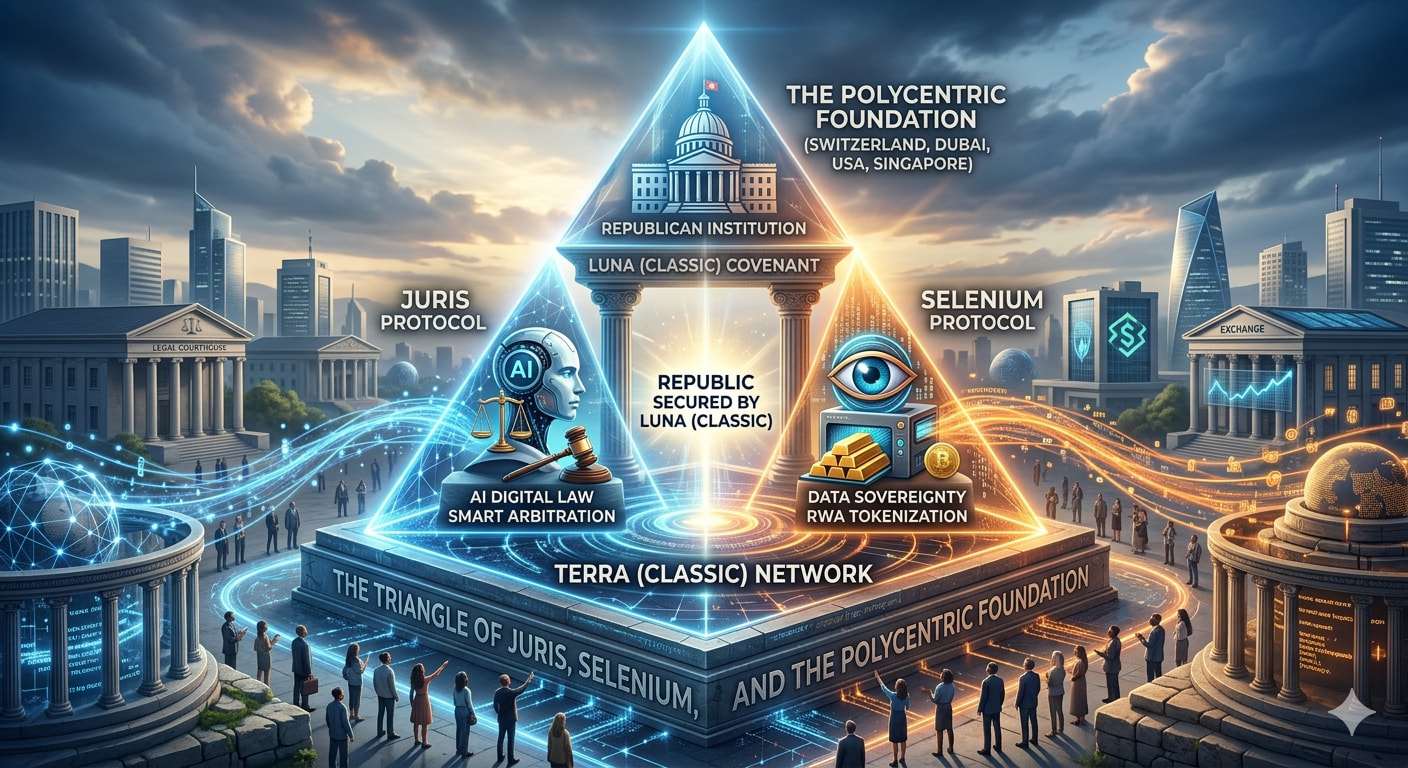
Introduction: Blockchain Freedom and the Necessity of a Republic
The world of blockchain is, by nature, a realm of limitless freedoms. However, we must remember that not everyone is an “angel,” and the Terra network is perpetually vulnerable to attacks. In a place where absolute democracy and unregulated freedom reign, attackers can infiltrate the network as agents and collapse the system from within.
This is why Terra must not be a chaotic structure governed solely by voting; it must be a structure built upon unshakable Republican Principles that no one can bypass. The “Luna Community Covenant,” which we defined previously, is the constitution of this network. The guardians that will protect, audit, and enforce these constitutional principles are the triangle of Juris, Selenium, and the Polycentric Foundation. Luna (Classic) remains the unshakable core value of this ecosystem and the coin through which governance is exercised.
1. Protocol Definitions: The Technological Guardians
What is Juris Protocol?
Juris is not a common AI tool; it is an enterprise-grade “Legal Operating System.”
AI Infrastructure: Juris utilizes top-tier LLM (Large Language Model) engines such as GPT-4o and Claude 3.5 for its core natural language processing. However, what makes it unique is the “Legal Playbook” layer built upon these engines.
Training Model: Juris AI is specifically trained not just on general data, but on curated legal datasets, including regulations, court rulings, and international trade law. Monitored by “Legal Engineers,” this system does not hallucinate; every response is anchored in a verified legal source.
Development Process: Now reaching its Mainnet phase, Juris specializes in Semantic Mapping technology, which aligns smart contracts with legal prose.
What is Selenium Protocol?
Selenium is the “central nervous system” and the “tokenization mint” of the network.
Technical Function: Selenium is a Data Indexer protocol. It captures, cleans, and transforms raw and complex data on Terra into meaningful evidence in real-time.
Tokenization Power: The true strength of Selenium lies in its role as the bridge bringing Real-World Assets (RWA) to the blockchain. By converting physical assets into “smart assets,” it automatically manages their entire on-chain lifecycle, including payments, ownership transfers, and collateralization ratios.
2. Functions and Exemplary Scenarios
Selenium: Data Sovereignty and Transparent Asset Management
RWA and Treasury Bill Tokenization:
Example: When the Foundation acquires a treasury bill or gold reserve from global markets, Selenium mints this asset onto the Terra network as a “verified-authentic” token. This represents “real asset collateral” instead of an “algorithmic fantasy.”
Advanced Indexing and Forensic Data Tracking:
Example: Selenium monitors in real-time whether an exchange is fulfilling its burn promises or engaging in divergent activities behind the scenes. It doesn’t just “read” data; it interprets it and provides the community with a non-manipulable “Transparency Report.”
Collateral Ratio and Risk Sensing:
Example: When the market value of the minted treasury bills drops, Selenium captures this data in milliseconds. This prevents the system from “crashing blindly”; it automates risk management.
Juris: AI-Powered Digital Law and Arbitration
AI-Assisted Contract Auditing (Redlining):
Example: A “2.5 Billion USTC Collateral Agreement” made with an institution is uploaded to Juris AI. The AI compares this contract against the red lines in the Luna Community Covenant. If there is a loophole endangering property rights, the AI rejects the contract or mandates its correction.
Automated Dispute Resolution (Smart Arbitration):
Example: If a dispute arises in a lending-borrowing relationship, Juris intervenes instead of waiting months for traditional courts. It takes the definitive evidence from Selenium regarding “non-payment” and transfers the asset to the rightful party in seconds.
Global Regulatory Compliance:
Example: Juris AI incorporates the latest laws from countries such as Switzerland, Dubai, the USA, and Singapore as “Playbooks.” Regardless of where the Foundation operates, the system adapts to local law in seconds.
3. The Polycentric Foundation: The Institutional Fortress of the Republic
At the apex of this system must be a Polycentric Foundation structure that is not captive to the pressures of a single nation but is integrated into global law.
Execution and Representation: The Foundation uses the technical power provided by Selenium and Juris to sign formal protocols with exchanges and international financial institutions.
Oversight and Republican Principles: Governance votes participated in by Luna (Classic) holders determine the Foundation’s strategies. However, no vote that would violate property rights or the core parameters of the system can bypass the “Luna Community Covenant” principles guarded by Juris and Selenium.
Conclusion: June 27th is a Turning Point
The salvation for Terra is not more populist rhetoric; it is controlling data with Selenium, building law with Juris, and institutionalizing this structure with the Polycentric Foundation.
The June 27th Mainnet date will be the day chaos gives way to the unshakable rules of a Republic secured by Luna (Classic).