USTC Recovery Framework: Expanding Utility and Supporting Depeg Affected Holders
USTC Native Staking System on Layer 1
Contents
1. Community Pool Allocation.. 7
2. Ecosystem Contributions.. 8
3. Protocol Revenue Sources.. 8
Economic Impact Simulation and Expected Advantages.. 9
Reduction of Effective Circulating Supply.. 9
Strengthening LUNC Staking Rewards.. 10
Additional Tool Supporting Market Module 2 (MM2). 11
Potential Positive Price Pressure Across the Ecosystem… 11
Addressing the disappointment of Depeg Victims.. 11
Recommended Reward Mechanism Framework.. 12
Inflation Model (USTC Only). 12
Validator Infrastructure Requirements.. 14
Technical Development and Security.. 15
Summary of Expected Benefits.. 16
Path Forward for Depeg-Affected Users.. 16
Improved Rewards for Validators and Delegators.. 16
Support for Market Module 2 (MM2). 16
Strengthening the Terra Classic Ecosystem… 16
Abstract
TerraClassicUSD (USTC) is a native asset of the Terra Classic blockchain. Prior to the depeg event in May 2022, UST served as the algorithmic stablecoin of the Terra ecosystem and played a central role in the network’s economic model.
Following the collapse and subsequent depeg, USTC lost most of its original functionality. Today, the token primarily serves limited purposes within the ecosystem, including:
- Payment of gas fees on the Terra Classic chain
- Trading pair liquidity on decentralized exchanges (DEXs)
- Participation in swap pools
With the upcoming Market Module 2 (MM2) - a non-minting version of the original swap mechanism expected to be tested after SDK53 deployment - USTC will gain additional utility by being paired directly with LUNC for on-chain arbitrage opportunities.
However, these utilities alone are not sufficient to support sustained demand for USTC and LUNC.
This proposal therefore explores the introduction of a native USTC staking system on Layer 1, enabling holders to lock their tokens on-chain and earn rewards.
Staking is one of the most widely used mechanisms in blockchain networks to encourage long-term participation and reduce circulating supply while providing economic incentives to users.
The objective of this proposal is to introduce a sustainable staking mechanism that complements existing USTC utilities, including:
- Gas payments
- DEX trading pairs
- MM2 arbitrage participation
- Future DeFi integrations
Background
Prior to the depeg event in May 2022, UST was the primary stablecoin of the Terra ecosystem and at its peak reached a circulating supply of approximately 18 billion tokens.
Following the collapse and subsequent burns, the current supply of USTC is approximately 6 billion tokens, which is roughly one third of the historical peak supply.
This distinction is important because it highlights a fundamental difference between USTC and LUNC supply dynamics.
During the collapse event, LUNC experienced massive over-minting, which resulted in trillions of tokens entering circulation.
USTC, however, did not undergo the same hyper-inflationary expansion, meaning its total supply remains significantly lower than its historical peak.
Because of this, USTC still has economic room to be used as an incentive layer within the ecosystem, allowing mechanisms such as staking incentives, ecosystem rewards, or controlled inflation models to be explored without facing the same structural limitations present with LUNC.
Goal
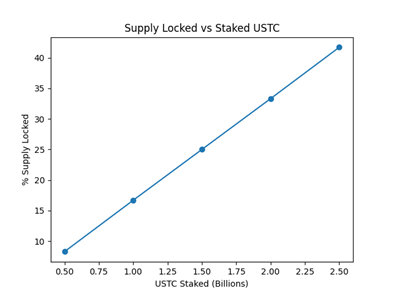
The primary objective of introducing a USTC staking mechanism is to remove a meaningful portion of USTC from liquid circulation, ideally targeting between 20% and 33% of the current supply.
A successful staking system would encourage users to withdraw USTC from centralized exchanges and lock those tokens on-chain, reducing the amount of USTC immediately available for sale on the open market.
This can produce several beneficial effects:
- Reduced short-term sell pressure
- Smaller sell walls on exchanges
- Increased long-term holding behavior
- Higher on-chain participation
- Higher virtual rewards for LUNC delegators and validators
- Arbitrage opportunities created by Market Module 2 (MM2), enabling it to scale..
Historically, staking mechanisms in cryptocurrency networks have demonstrated the ability to reduce circulating supply while incentivizing long-term token holding.
Additionally, USTC price movement has direct implications for the Terra Classic staking ecosystem.
Validators and delegators who stake LUNC currently receive rewards in multiple assets, including USTC.
If the value of USTC increases, the real yield of LUNC staking also increases, which can improve the attractiveness of LUNC staking and strengthen validator sustainability across the network.
Expected Ecosystem Impact
A successful staking system attracting 20‑33% of the
circulating supply could significantly reduce liquid supply, increase demand for USTC, strengthen LUNC staking rewards, and increase on‑chain activity within the ecosystem.In order for a staking system to function effectively, a reward distribution mechanism must be established to incentivize delegators to lock their USTC on-chain.This proposal does not enforce a single funding source for the reward pool. Instead, it proposes the creation of a dedicated USTC reward pool, similar in concept to the existing LUNC Oracle Pool, which distributes rewards to validators and delegators based on network participation.The goal of this pool would be to provide sustainable incentives for USTC staking while maintaining flexibility in how rewards are funded over time .Several potential funding sources could be explored by the community, including but not limited to:
1. Community Pool Allocation
The Terra Classic community pool currently holds approximately 61 million USTC , which could serve as an initial bootstrap fund for the USTC staking system.
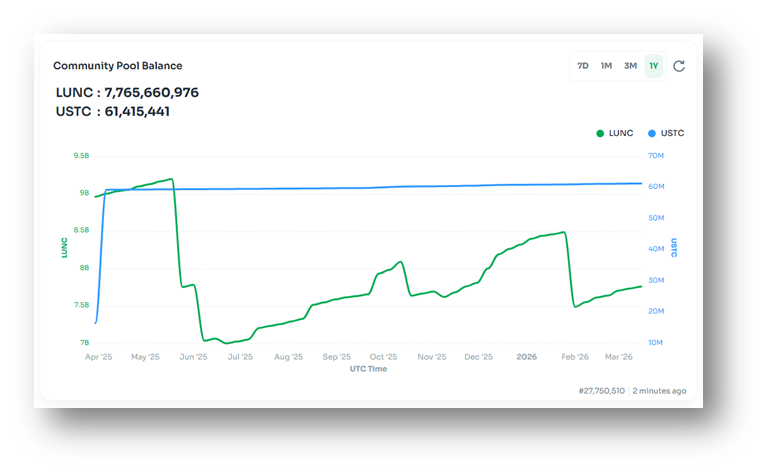
Using a portion of these funds could allow the network to launch the staking system without introducing immediate inflation , while evaluating long-term sustainability.
2. Ecosystem Contributions
Projects building within the Terra Classic ecosystem may voluntarily contribute tokens or incentives to the staking reward pool in order to increase the attractiveness of the network.
Such contributions could include:
Native USTC deposits
Ecosystem incentives
Strategic reward campaigns
This approach would allow the ecosystem to support staking incentives without requiring mandatory protocol changes. Only native USTC (probable Lunc as well) would be used for rewards, as supporting CW20 tokens would require the development of an additional Layer 2 module.
3. Protocol Revenue Sources
Future network revenue streams could also contribute to the staking reward pool. Examples include:
Market Module 2 arbitrage fees
Swap fees from DEX liquidity pools
Gas fee allocations
Burn tax redirections
As Terra Classic evolves, protocol-level revenues could partially sustain the staking incentives , reducing the need for external funding.
4. Controlled Inflation
As a final option, the community may consider the introduction of controlled inflation on the USTC side of the network , similar to how many proof-of-stake blockchains fund staking rewards.It is important to note that USTC inflation differs significantly from LUNC inflation dynamics , since USTC supply today remains significantly below its historical peak supply of approximately 18 billion tokens .Because of this, the Terra Classic ecosystem still has economic flexibility to utilize USTC as an incentive mechanism if governance chooses to explore that path in the future .However, this proposal does not mandate inflation and instead presents it only as a possible long-term funding option that would require separate governance approval.
.
Economic Impact Simulation and Expected Advantages
To better understand the potential effects of introducing a USTC staking system, it is useful to examine a simplified scenario based on current circulating supply.
The circulating supply of USTC is currently approximately 6 billion tokens.
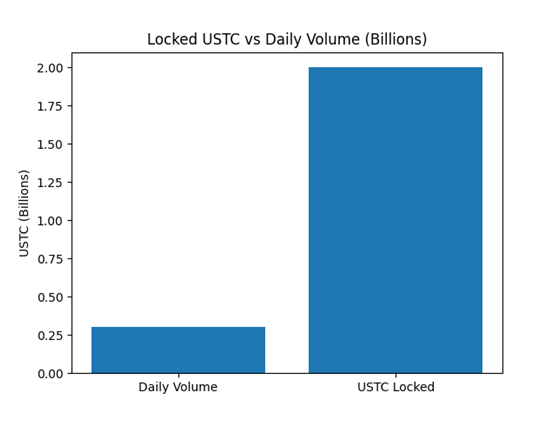
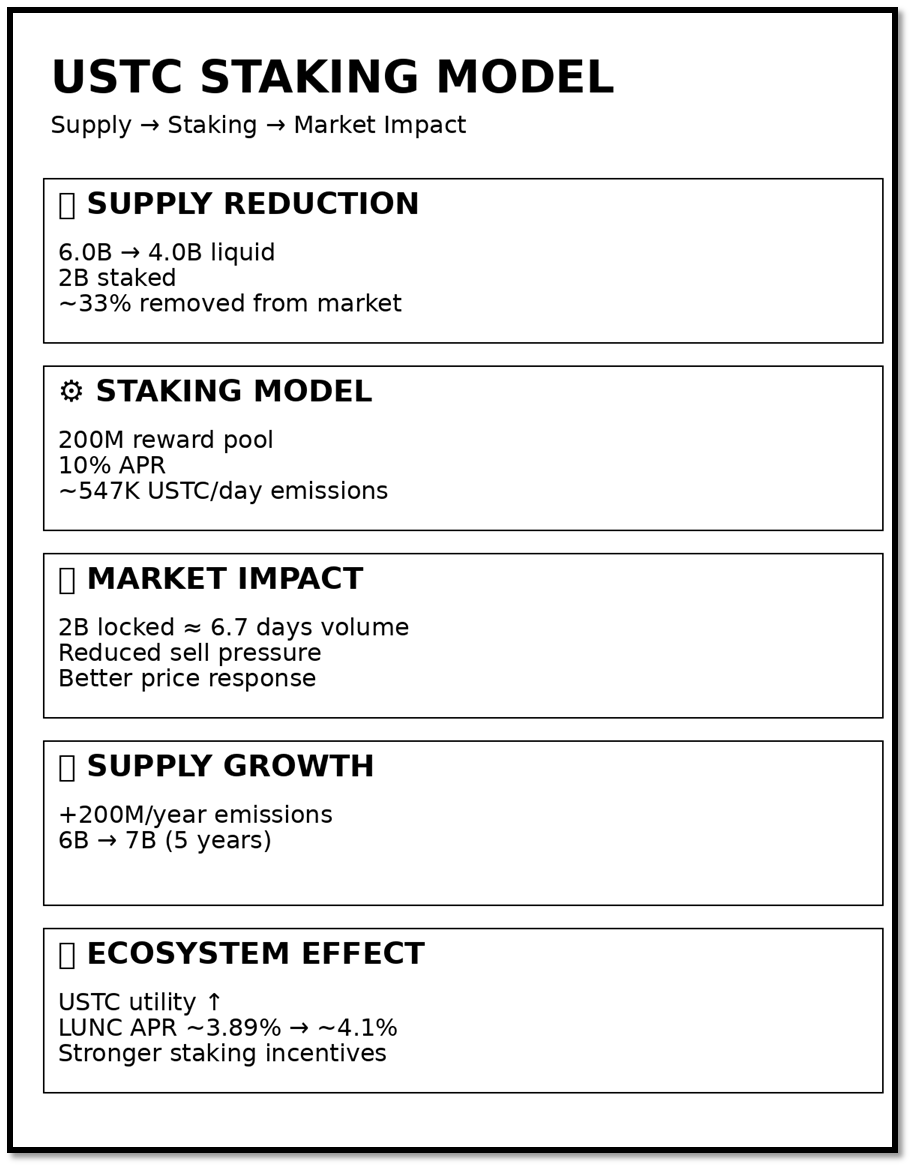
If a successful staking mechanism attracts between 20% and 33% of the circulating supply, this would result in approximately:
- 1.2 billion USTC staked (20%)
- 2.0 billion USTC staked (33%)
Removing this amount of USTC from liquid circulation could significantly reduce the amount of tokens available on centralized exchanges and open markets.
Historically, staking mechanisms in cryptocurrency networks reduce immediate sell pressure by locking tokens for longer periods while providing incentives for long-term holding.
This mechanism could therefore produce several advantages for the Terra Classic ecosystem.
Reduction of Effective Circulating Supply
If between 20–30% of USTC is removed from liquid circulation, the effective supply available for trading decreases.
This may:
- Reduce large sell walls on exchanges
- Lower short-term sell pressure
- Encourage long-term holding behaviour
- Increase on-chain participation
In practical terms, the goal would be to move a meaningful portion of USTC from centralized exchanges back to on-chain staking, strengthening network activity.
Strengthening LUNC Staking Rewards

Validators and delegators who stake LUNC currently receive rewards composed of multiple assets, including USTC rewards distributed through the network reward system.
If USTC demand increases and the market price of USTC rises, the real value of LUNC staking rewards also increases, since part of the rewards paid to delegators are denominated in USTC.
For example:
If USTC price appreciation occurs due to reduced circulating supply and increased staking demand, the effective APR of LUNC staking may increase as well, improving validator sustainability and making delegation more attractive.
This could provide:
- Higher effective APR for delegators
- Additional income stability for validators
- Stronger validator commitment to network operations
Additional Tool Supporting Market Module 2 (MM2)
The introduction of a staking mechanism may also support the development and adoption of Market Module 2 (MM2).
As USTC becomes more actively used and held on-chain, it increases liquidity availability for LUNC–USTC arbitrage mechanisms, which are expected to be part of the MM2 design once deployed after SDK53.
This creates an additional economic layer where:
- USTC staking reduces circulating supply
- MM2 creates arbitrage opportunities
- Increased activity strengthens the on-chain economy
Potential Positive Price Pressure Across the Ecosystem
If demand for USTC increases due to staking incentives and tokens are removed from exchanges for on-chain participation, market dynamics may lead to increased price activity for both USTC and LUNC.
A stronger USTC market can indirectly strengthen the entire ecosystem by:
- Increasing LUNC staking yield value
- Encouraging new users to participate in the network
- Expanding economic activity on Terra Classic
Addressing the disappointment of Depeg Victims
Many users within the Terra Classic community were significantly affected by the UST depeg event.
While no mechanism can fully reverse the losses that occurred, introducing new economic tools such as USTC staking may provide a path for affected users to participate again in the ecosystem and earn rewards over time.
This proposal therefore attempts to create a long-term recovery opportunity for users impacted by the depeg, by introducing mechanisms that allow holders to generate yield rather than leaving USTC without meaningful utility.
Recommended Reward Mechanism Framework
To bootstrap the staking system while maintaining sustainability, the following model is suggested for discussion.
Initial Bootstrap Phase
The Terra Classic community pool currently holds approximately 61 million USTC, which could be used to initiate the staking reward pool.
These funds could serve as the initial reward distribution source, allowing the staking system to launch without immediate protocol inflation.
Inflation Model (USTC Only)
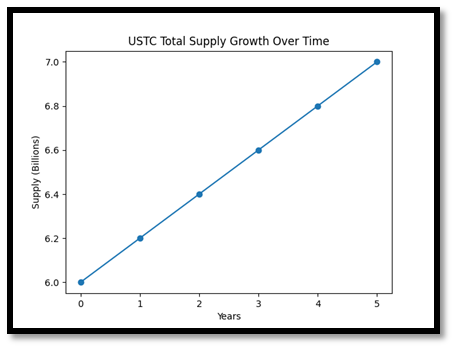
For long-term sustainability, the network could explore a controlled inflation mechanism for USTC, similar to reward structures used in many proof-of-stake blockchains.
Since the current USTC supply (~6 billion) is significantly below its historical peak (~18 billion), the ecosystem retains flexibility to use USTC inflation as an incentive mechanism.
Under this model:
- Controlled USTC inflation could fund staking rewards
- Inflation would be distributed gradually through validator rewards
- Governance would retain control over inflation parameters
Importantly, this mechanism would apply only to USTC, not to LUNC.
Hybrid Funding Approach
A hybrid model could also be explored where rewards are funded from a combination of:
- Community pool allocations
- Controlled USTC inflation
- Protocol revenues (e.g., MM2 fees or network fees)
- Voluntary ecosystem contributions
This flexible approach would allow the network to adjust reward funding as the ecosystem evolves.
Risks and Considerations
While a USTC staking system may introduce new utility and strengthen on-chain participation, it is important to acknowledge potential risks and considerations associated with implementing such a mechanism.
Market Volatility
Cryptocurrency markets are inherently volatile, and the introduction of staking incentives does not guarantee price appreciation for USTC or LUNC.
While reducing circulating supply may decrease immediate sell pressure, market prices remain influenced by broader market conditions, trading activity, and external factors beyond the Terra Classic network.
For this reason, staking should be viewed primarily as a utility mechanism rather than a price guarantee.
Inflation Management
If governance eventually chooses to introduce controlled inflation for USTC to sustain staking rewards, careful management of inflation parameters will be required.
Excessive inflation could weaken long-term token value if it outpaces demand growth.
Any inflation mechanism should therefore be:
- Gradual
- Transparent
- Adjustable through governance
This would allow the community to monitor the economic effects and modify parameters if necessary.
Validator Infrastructure Requirements
Introducing a new staking module would require validators to run updated software and support the additional functionality.
Although the infrastructure requirements are expected to be similar to existing staking systems on Cosmos-based networks, validators would still need time to upgrade and integrate the new module.
For this reason, implementation should include sufficient upgrade timelines and testing periods before activation.
Liquidity Considerations
If a significant percentage of USTC becomes staked, the available liquidity on exchanges and decentralized markets may decrease.
While reduced liquidity can support price stability in some scenarios, it may also increase price volatility during large buy or sell orders.
This dynamic should be monitored as the staking system grows.
Governance Oversight
As with any new economic mechanism, ongoing governance oversight will be essential.
Future adjustments may be required regarding:
- Reward distribution parameters
- Inflation rates (if implemented)
- Funding sources for reward pools
Maintaining governance control ensures the community retains the ability to adjust the system as the ecosystem evolves.
Technical Development and Security
Before implementation, the proposed staking system would require:
- Detailed technical specifications
- Security reviews and testing
- Developer implementation and code audits
These steps are essential to ensure that the mechanism operates securely and integrates properly with the existing Terra Classic infrastructure.
Only after proper testing and governance approval should any changes be deployed to the main network.
Summary of Expected Benefits
The introduction of a native USTC staking system could provide several advantages for the Terra Classic ecosystem.
Path Forward for Depeg-Affected Users
While the losses from the UST depeg cannot be reversed, introducing staking offers USTC holders a way to participate in the network and earn rewards, providing a constructive path forward for the community.
Improved Rewards for Validators and Delegators
Because part of LUNC staking rewards are distributed in USTC, increased demand and activity around USTC may improve the effective APR for delegators and provide additional income opportunities for validators.
New Utility for USTC
Staking would introduce a major new utility for USTC, complementing its existing uses such as gas payments, DEX trading pairs, liquidity participation, and future integrations with Market Module 2 (MM2).
Support for Market Module 2 (MM2)
Higher on-chain USTC participation may strengthen liquidity for LUNC–USTC arbitrage, helping MM2 scale and improving overall market efficiency.
Strengthening the Terra Classic Ecosystem
By increasing utility, encouraging long-term holding, and improving staking incentives, this mechanism may contribute to stronger network activity, validator sustainability, and long-term ecosystem growth.
Conclusion
USTC was once a central component of the Terra ecosystem, serving as the network’s algorithmic stablecoin and supporting a large portion of the economic activity on the chain. Following the depeg event, the token lost most of its original function and today has only limited utility within the Terra Classic ecosystem.
While upcoming improvements such as Market Module 2 (MM2) may introduce new arbitrage opportunities and trading activity between LUNC and USTC, additional mechanisms are needed to provide sustainable utility and long-term demand for the asset.
Introducing a native USTC staking system on Layer 1 represents a practical and widely used approach to addressing this challenge.
Staking could:
- Provide direct utility for USTC holders
- Encourage users to move tokens from exchanges back on-chain
- Reduce circulating supply by locking tokens through delegation
- Increase on-chain participation and network activity
- Strengthen the LUNC staking economy, since part of LUNC rewards are paid in USTC
- Create oportunies for MM2 arbitrage
- Give a final resolution for the community menerbers that lost during depeg event.
With USTC supply currently around 6 billion tokens, significantly lower than its historical peak of approximately 18 billion, the ecosystem retains economic flexibility to explore incentive mechanisms such as staking without facing the same structural limitations present with LUNC supply.
By removing a meaningful portion of USTC from liquid circulation and encouraging long-term participation, a staking system could become an important tool in strengthening both USTC utility and the broader Terra Classic network economy.
This proposal does not mandate immediate implementation but instead seeks community support to explore the development of a USTC staking framework.
References
-
Is Crypto Staking Worth It in 2026? Returns, Risks & How It Works
-
TerraClassicUSD price today, USTC to USD live price, marketcap and chart | CoinMarketCap
-
https://lcd.terra-classic.hexxagon.io/cosmos/bank/v1beta1/supply/by_denom?denom=uusd
Vegas
 Prevents immediate sell pressure and price collapse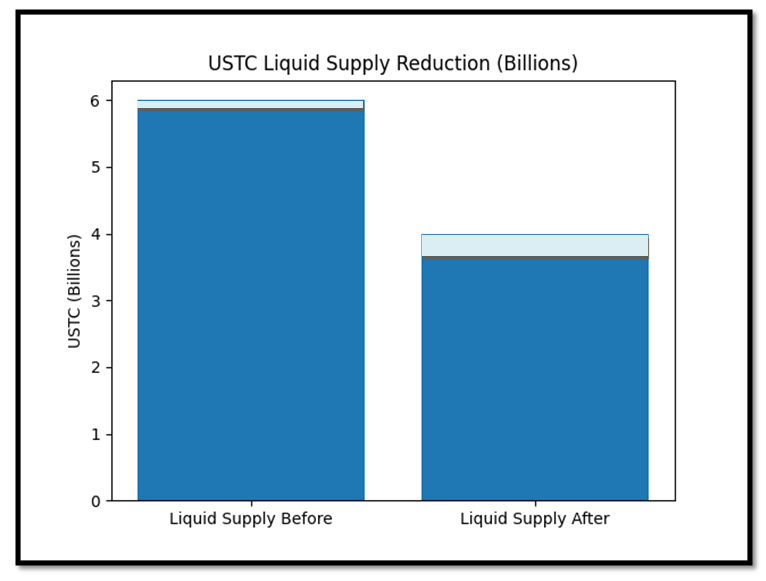

 I support USTC staking
 I DO NOT support USTC minting.
 thank you ,yep, we need to go by steps as the community is not ready for radical changes,and who knows maybe we dont even need minting and MM2 can support the all system.